Seals, on their own
A seal is artwork until the panel supports it. Good manufacturing practice describes record-keeping and a registered-facility mark describes a registration. Neither approves a formula.
Free reading
Seven checks you can run on any product on this shelf in about two minutes — and the same seven run against the product this website sells, which fails four of them.
Written and reviewed by the SodaPeak Editorial Desk · Last updated September 22, 2026
Quick answer
Seven checks, each answerable from a product’s own published material. Is there a Supplement Facts panel at all. Does the marketing image name the same ingredients as the panel. Is there a declared amount or only a proprietary blend. Are the species and plant parts printed. Does every seal survive a check against the ingredient list. Is there a published price before checkout. Is the refund window stated as a number of days. SodaPeak passes the first and fourth strongly and fails four: six ingredients in the marketing against eight on the panel, a vegetarian seal contradicted by a gelatin capsule and an animal-derived glandular ingredient, no price before checkout, and no window length published anywhere.
Before you start
Nobody can tell you which muscle support supplement works, because for most of this shelf there is nothing to tell. What you can do, in about two minutes on a phone, is establish whether the seller has told you enough to decide at all.
That is what the seven checks below do. Each is answerable from the product’s own published material, and none asks you to judge an ingredient or trust a review. A product that cannot give you seven yeses is one you would be buying with less information than you could have had.
Run them in order. The first three are about the panel, the middle two about whether the packaging tells the truth about itself, and the last two about what you are paying.
The method
Seven questions with a yes or a no, in the order that wastes the least of your time.
Not an ingredients paragraph and not a list of benefits with leaves drawn round it: the boxed panel, with a serving size, a servings-per-container line and amounts. A listing with six glamorous photographs and no panel has made a choice about what you read.
Count the names on the card, then on the panel. They should match. When they do not, the panel is right — it is the regulated document and the card is an advertisement — and marketing naming fewer ingredients than the label has left something out.
A full panel prints an amount beside every ingredient, which lets you compare one of them to whatever research exists. A blend prints a single total. That is permitted, provided members are listed in descending order by weight, and that ordering is all you get: first is biggest, last is smallest, and nothing says which.
The two-word Latin name, and the part of the plant used. Several plants share an English name and are different species, and root and leaf of one plant carry different research. A panel printing both knows what it bought.
Take each seal on the front and try to break it with the panel on the back. The vegetarian seal fails most often, and the ingredient that breaks it is usually the capsule shell: gelatin is animal collagen, sitting at the end of the other-ingredients line where nobody reads. Where a seal and the panel disagree, the panel wins.
You should see what a bottle costs, and what a multi-bottle pack costs, before you hand over an address or a card number. A price that appears only at the last step removes the one easy comparison across this shelf: cost per serving.
Not a seal, not the phrase satisfaction guaranteed. A number, with the word days after it, and a sentence saying who pays return postage and when the clock starts. If the guarantee points at a marketplace return window instead, that is the platform’s policy rather than the seller’s promise.
In practice
The order is doing work. Checks one to three tell you whether a panel exists and whether it is worth reading. Checks four and five tell you whether the company describes its own product accurately, which is the best single predictor of how it behaves when something goes wrong. Six and seven tell you what you are agreeing to.
Three practical notes. Screenshot as you go, especially the price and the refund wording, with the date visible; listings change. Use the panel photograph, not the description — descriptions are typed by marketing teams and panels are photographed off the bottle. And phone them if a number is published: asking which animal a glandular ingredient came from is a fair question with a short right answer.
The honest section
| The check | Result | What the material shows |
|---|---|---|
| 1. A Supplement Facts panel exists | Pass | A full boxed panel with serving size, servings per container and a declared blend total. |
| 2. Marketing names the same ingredients as the panel | Fail | The panel names eight. The seller’s pack and both listing cards name six. |
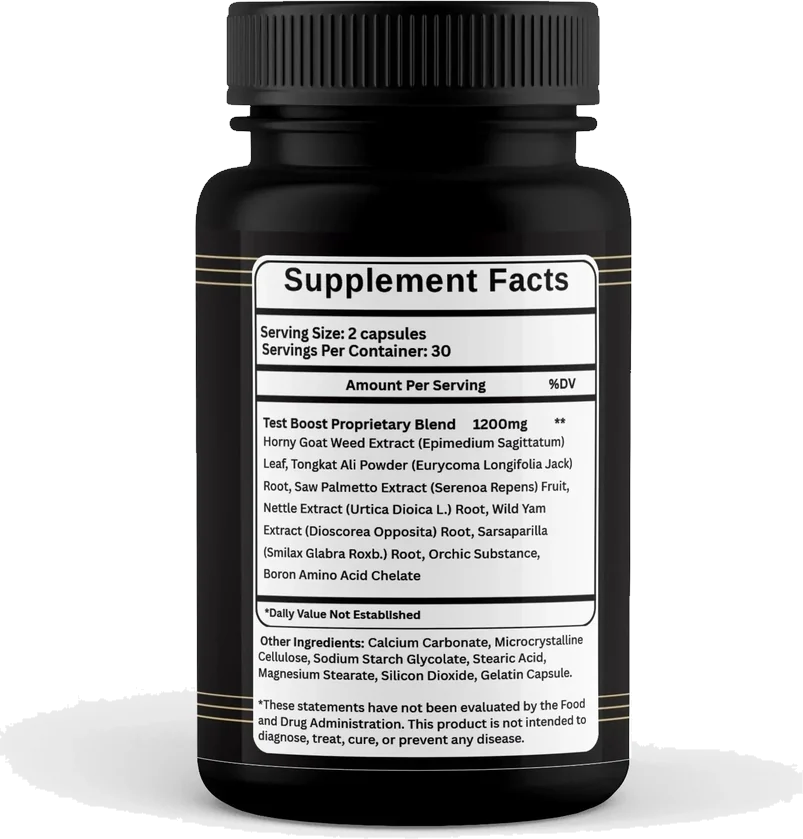
| 3. A declared amount rather than a blend total only | Part pass | A declared 1200 mg total, and no amount for any of the eight inside it. |
| 4. Species and plant parts printed | Pass | Six binomial species and six plant parts. The other two are not plants. |
| 5. Every seal survives the ingredient list | Fail | The vegetarian seal does not. The panel prints a gelatin capsule and an animal-derived glandular ingredient. |
| 6. A published price before checkout | Fail | No pack price was supplied to us. Every price here reads “at checkout”, because that is the only place one appears. |
| 7. A refund window stated in days | Fail | A money-back seal, and a guarantee described as being as printed on the listing. No length is published anywhere in our sources. |
Two strong passes, one partial, and four clear failures. We sell this product, and that is the score. A page that ran its own checklist and found its own product passing everything would not be one.
The honest section
The bottle’s Supplement Facts panel names eight ingredients inside the blend. The seller’s product pack names six. The “Inside SodaPeak” card names six. The “How SodaPeak Works” card names the same six. Orchic Substance and Boron Amino Acid Chelate appear only on the label. The label is the regulated document, so both are published here, on every list, in the order the panel prints them.
A vegetarian seal appears in the packaging artwork supplied with this product. The label itself says otherwise, twice over. The Other Ingredients line ends “Gelatin Capsule”, and gelatin is made from animal collagen. The blend itself contains Orchic Substance, which is glandular tissue of animal origin. Neither of those is a borderline case, and neither is hidden: both are printed on the panel in plain sight.
If you avoid animal-derived ingredients, this product is not for you, and the seal on the box is wrong. The label wins, and on this point the label is unusually easy to read.
No pack price was supplied to us, so every price on this site reads “shown at checkout”.
There is a money-back seal, and the supplied pack says the guarantee is as printed on the listing, often the marketplace return window. No length is given anywhere. Read it where you pay, and screenshot it with the date.
The other end
The other end of the scale exists, and it is not exotic.
A product passing all seven shows a photograph of its panel on the listing page, before you click anything. The panel names every ingredient with an amount, a binomial species and a plant part, and the marketing card names exactly those and no others. Every seal traces to a line on the panel. A price for each pack size is visible without entering an address. And the refund policy is a paragraph with a number of days in it.
None of that is expensive. All of it is a decision about whether the buyer is supposed to be able to check.
Skip these
A seal is artwork until the panel supports it. Good manufacturing practice describes record-keeping and a registered-facility mark describes a registration. Neither approves a formula.
If no clinician is named, with credentials you can look up, the phrase is marketing language. A name you cannot verify would be worse than no name.
An average says nothing about who wrote it. Weight a published star split and see whether it gives the headline figure above it.
Not a check. Nothing on this shelf may promise a visible outcome, and an image doing so has made a claim the label could not.
What then
A failure is information, not a verdict. What you do with it depends on which one failed.
Check one — no panel you can see. Do not buy until you have seen one. Checks two and five — the packaging contradicts the panel. Believe the panel, then decide whether the contradiction affects you: a missing mineral is a tidiness problem, an undisclosed animal-derived ingredient is not. Check three — buy it as a habit rather than as a strength. Checks six and seven — get to the checkout screen anyway, read both, screenshot them, and then decide. You are allowed to leave a checkout page.
And one that is not on the list, because it is not about the product: show the full ingredient list to a pharmacist before a first bottle, especially if you take anything prescribed.
Questions
It is a large blend total by the standards of this category, and it is still one number split eight ways. Two of those eight are not botanicals at all. Without a split you cannot compare any single ingredient to the research on it.
No. A vegetarian seal appears in the packaging artwork, but the label’s own other-ingredients line ends “Gelatin Capsule”, and the blend contains orchic substance, which is animal glandular tissue. Both are animal-derived and both are printed in plain sight on the panel.
Because the marketing and the label disagree. The seller’s pack, the “Inside SodaPeak” card and the “How SodaPeak Works” card all name six botanicals. The Supplement Facts panel names those six plus orchic substance and boron amino acid chelate. The label is the regulated document, so this site publishes all eight.
No pack price was supplied to us. Every price on this site reads “shown at checkout”, and the marketplace listing is where the figure you will actually be charged appears.
The packaging carries a money-back seal, and the supplied pack says the guarantee is “as printed on the listing”, adding that this is often the marketplace return window. No length was given to us, so we do not print one. A marketplace return window is the platform’s policy rather than the seller’s promise, which is worth knowing before you rely on it.
References
Next
What this shelf is, which ingredients recur, and what any of them may say.
Read it →The six in every marketing image, and the two only the bottle names.
Read it →What is published about it, and why a marketplace window is not a promise.
Read it →Everything the checks need is on this site: the panel word for word, all eight ingredients, every seal explained and the guarantee wording as supplied. The price and the refund window are on the listing, which is the sixth and seventh failures and the reason to screenshot both. Order desk +1 (302) 200-3480.
Price and money-back window on the listing · ships from inside the US · order desk +1 (302) 200-3480